
Hierarchies of Living Spaces
Psychoanalysis and the Ojai Garage
ARTWORKS BY TOM PAZDERKABuildings live their own psychic lives. This is the thesis of French philosopher Gaston Bachelard which he proposed in a 1958 book The Poetics of Space. Hovering somewhere between psychoanalysis and poetry, The Poetics of Space revealed to its readers a direct phenomenological link between experiences and physical spaces. The physicality of corners, their right angles apparently make them specifically suitable for placing chairs on which one can read or daydream or for the child to be put into a time-out for causing trouble. One remembers the first set of stairs heading down toward a basement more readily than any other staircase, because the basement recalls an entrance into the unconscious depths of the mind of the house.
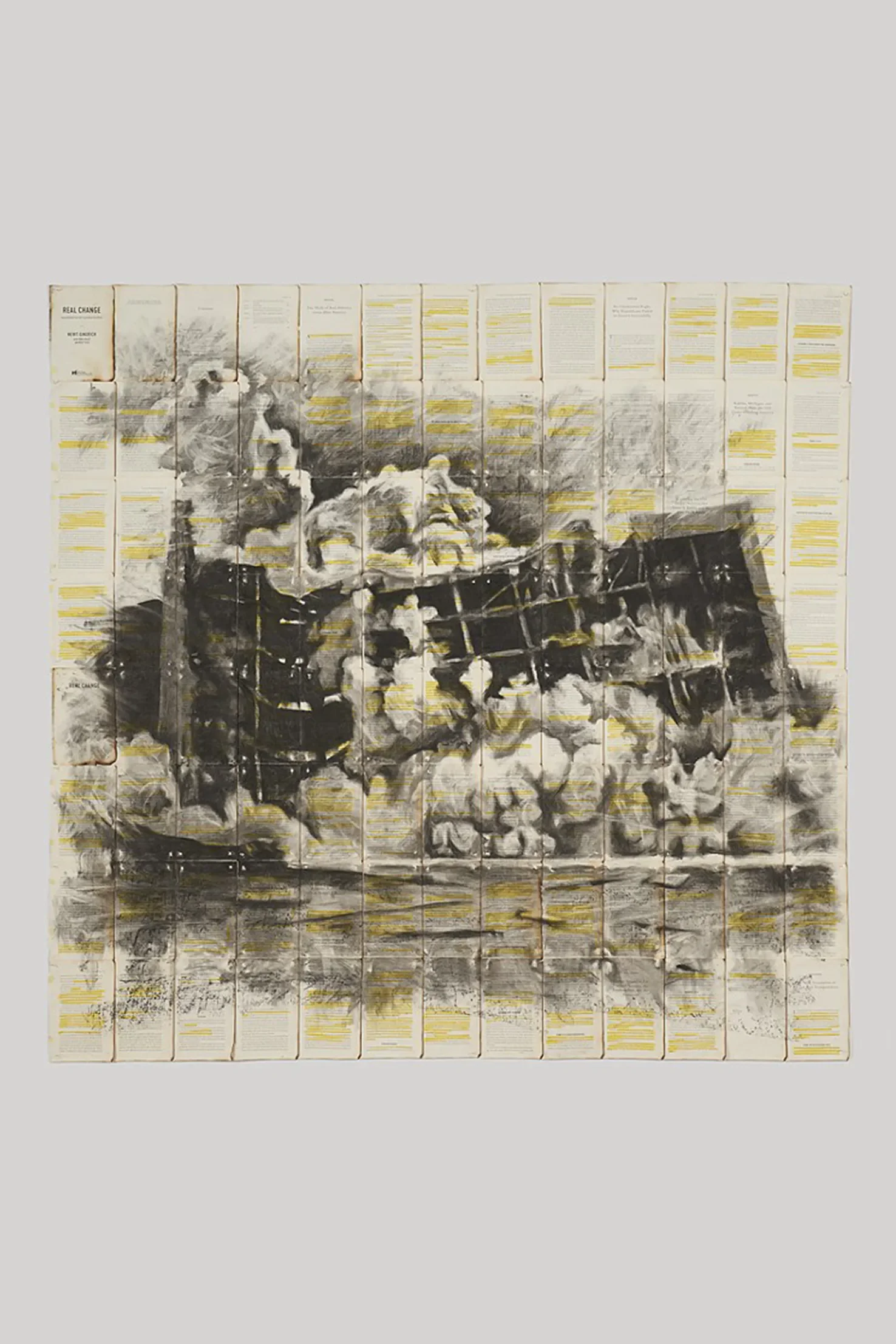
FALLING TWILIGHT, 2014
In European cities the verticality of houses on a packed street means that basements are crucial for storage of food while attics were ‘extra’ storage spaces, in other words, they are repositories of memories, old clothes, and family photo albums. Basements serve as storage that keeps food and drink cold. But these spaces are much more than that. Somewhat more recently, the Slovenian philosopher Slavoj Žižek described the multi-storied house as a symbolic representation of the human psyche, based on the Freudian psychoanalytic model, in which the attic represents the super ego (the higher self, the symbolic authority of morals), the main house as ego (the self), and the basement as the id, the inner desire (instincts and drives). Žižek explored this symbolism most notably in Alfred Hitchcock’s classic film Psycho in a now notorious documentary film The Pervert’s Guide to Cinema (2006). Played by Anthony Perkins, Norman Bates, the lonely and mentally disturbed motel manager that murders the main character Marion Crane (Janet Leigh), is the embodiment of this triad in action. At the motel, the level of the ego, Bates appears to be normal, composed and charming, yet when we hear his mother’s voice coming from the house above the motel, the level of the super ego, we discover it is in fact Bates, who acts out the role of his caregiver. He wears her clothes, shouts, scolds and screams commands, while the decomposing body of Bates’ mother is quietly stored away (repressed) in the fruit cellar, the base layer of primordial instincts or drives: sex, violence, hunger, desire, etc.
CLOUD(S) I, 2014
Later in Poetics of Space Bachelard asks what happens to houses that have no basements and no attics? We do have an answer for that. The American ranch-style suburban house substitutes horizontality for the verticality of large cities. Here closets often substitute for the functionality of basements and garages are similar storage repositories to the attics of Europe, though none of these are exactly one-to-one comparisons. Garages are liminal spaces, linking the outdoors with the indoors. Their primary function was meant to be storage for the family car, but that is hardly what they are used for these days. In films as in real life, American garages have historically been used as extra storage, wood shops, start up offices, artist studios, man caves, apartments and serial killer torture chambers, among other things.
Every house in my neighborhood has a garage, yet hardly half the tenants actually use their garages for their intended purpose, to house a car. My neighbor once ran a small order fulfillment business out of his garage. Another neighbor who just moved in uses the garage for storage of stuff that doesn’t fit inside the house, which is the case with the majority of my immediate neighbors on my street. This neighbor is the third one to rent the house. Each previous neighbor also used the garage as storage. One neighbor one street over actually has his car in his garage, but he also has a big screen TV, a work out machine and chairs to hang out in, filling out the ubermensch cave atmosphere of the place. For all their variety, these uses share one thing: they are all forms of storage. Lately I’ve noticed a different category. The garage now stores not just stuff, but surplus humans. With the rising costs of housing, homeownership is increasingly becoming a thing of the past for a large portion of California’s population. At the same time landlords have discovered that renting out properties no longer satisfies those same increases in values. It is (so far) cheaper to rent than it is to own in towns like Ojai, yet the same intrepid landlords have discovered a workaround, namely, using vague definitions of ADUs to turn garages into apartments, and thus closing the price gap between rents and mortgages.
CLOUD(S) II, 2014
Whether borne of necessity or opportunism, garages have become prime targets. In a neighborhood where half a duplex costs almost as much as a single-family home, landlords have seen the hidden value in the ADU policy’s vague language. Some of them, having bought their side at the top of the market, have been busy: splitting the garage off from the main house, adding a kitchen and bath to the 400-square-foot concrete slab, then renting each unit for what the whole once cost. Where before the rent for a home with the garage and a yard was around $2500-$3000 per month, with the garage ADU, landlords now collect double that amount. That is how one gets to collect the value of the mortgage and possibly a little bit on top while at the same time ‘solving the housing crisis.’ The ongoing debate over affordable housing elides the fact that ADUs are always meant to increase the value of a property, which is ironic, because theoretically the increase of housing supply is supposed to have the opposite effect. It is a smart move if you’re a landlord, a shady, possibly evil move to the tenant priced out of the housing market.
ELEGIES TO FAILED REVOLUTIONS, RIGHT WING ROCK N ROLL , 2014
Not since the Great Depression have things been this bad and unequal. The Depression was the first time that writers noticed that garages didn’t store cars, but entire families, the result of the great migration of people from places like Oklahoma during the Dust Bowl toward the mirage of a free and prosperous California. But the Okies were a qualitatively different sort of society crowding inside this surplus space. Their entire net worth was what they could fit inside and on top of a single old Ford Model T. Savings, prospects? Non-existent. Crowding inside the ADU garage today are retirees with nest eggs and 401Ks, bachelorettes with consulting jobs and young couples with kids, most of them full-time employees.
To get really abstract, what the modern housing crisis suggests is that garages have become not just storage spaces for surplus humanity, but long-term depositories of the Lacanian ‘Real’ of class antagonism. To put it more bluntly, what is repressed here is the reality undergirding the modern capitalist fantasy of financialization, represented by the K-shaped economy–accumulation of assets and capital and rent seeking for the rich, with decreasing ownership and asset depletion, for the rent-paying downwardly mobile middle and lower classes–which translates into the largest upward transfer of wealth in the history of modern civilization.
ELEGIES TO FAILED REVOLUTIONS, HOLIDAYS IN OKLAHOMA, 2014
The Lacanian ‘Real’ is really an idea similar to the Freudian concept of repression. While at the level of the unconscious, what is repressed is something that the conscious mind cannot process without sustaining critical psychic damage, such as grief or shock sustained during a particularly violent event; at the level of mass unconscious, what is repressed is everything that cannot be safely absorbed by social norms, that is, what cannot be absorbed is the symbolic decomposing body of the mother in the fruit cellar. This repression applies to social structures as large as nations and religions, to some as small as families and one’s social circles.
This is why in capitalist society the homeless present such a massive problem. Their existence upsets the capitalist utilitarian fantasy of a perfectly efficient system, which is why their presence is always handled with some form of repression, either through actual physical removal (out of sight, out of mind) which is more common, or through the repression of their symbolic existence from the mediated mental spaces that we all occupy. This repression usually takes the form of demonization, such as pointing fingers at the rampant drug use and addiction among homeless people and to the urban blight of tent cities, which has the effect of removing them from polite society on the grounds such that the homeless person, simply for being homeless, violates the basic principles of the social contract.
The problem is that the trajectory of modern capitalism seems to be to create more people that are poor and/or unhoused and the garage apartment is one stepping stone toward that reality. It also seems that Americans have grown to accept lower living standards for each generation as something natural and capitalist realism as an unquestionable dogma. In a society of landlords and tenants, the tenant is always one bad event, one bad month, or one bad conversation with the landlord, from homelessness. Not to be unfair, the landlords also walk a similar tightrope. With increasing insurance costs and prices for materials and services, many smaller owners have seen their margins disappear and there is now a very faint line between them and bankruptcy should the economy continue on its collision course with reality.
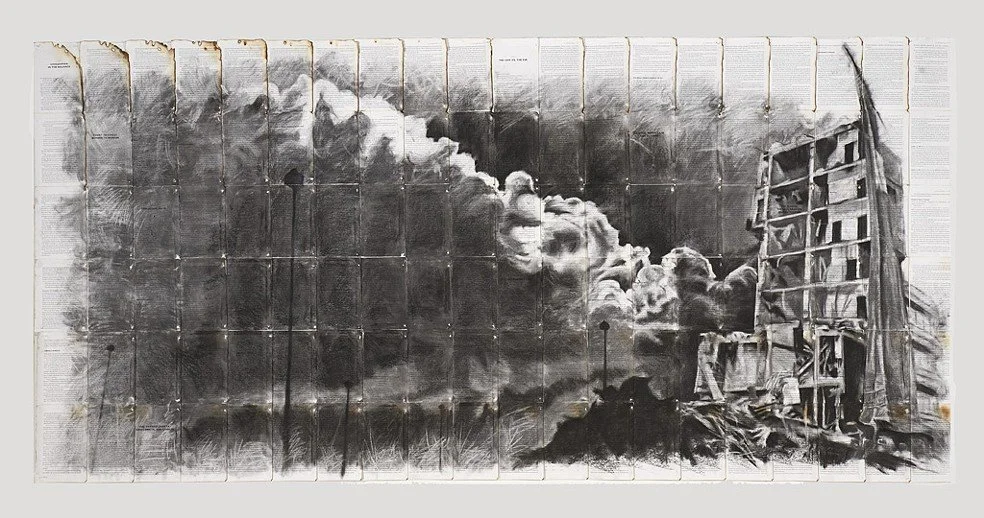
ELEGIES TO FAILED REVOLUTIONS, THE DAY AFTER THE END OF TIMES
There seems to be a growing movement behind the idea of housing as a human right. In the sense that all humans require food, water, and shelter as basic necessities for life, it is surprising that we are at a point in the 21st century where shelter is precisely the one thing that is systematically denied to millions of people worldwide through intricate mechanisms of financialization, taxation, and warfare. Even the noted Enlightenment humanist John Locke (1632-1704) understood the calculus imposed on an autocratic colonial society administered by aristocratic despots. He countered their self-proclaimed authority with a simple triad of human rights, “life, liberty, and estate” knowing full well that their mass adoption is the only way toward a semblance of an egalitarian society free from the coercion of a powerful class minority with concentrated wealth. Ironically, it was Thomas Jefferson who adapted Locke’s dictum, replacing ‘estate’ with ‘property’ and later still swapping ‘property’ with ‘the pursuit of happiness,’ establishing a precedent for vague language becoming the lynchpin for opportunists the world over. It is their sport to contest the meaning of words and such things as happiness, ownership, and property, and to degrade civil rights and mass movements to semantics and language games.
If shelter became a right, it would be incumbent on the government to defend it and to solve the problem of homelessness through resource allocation, rather than through coercion and repression. And perhaps after that comes to pass, housing would finally be universally understood as a public good, rather than a market to be exploited.
HEY GET A WEBSITE