Corb's Orbs
Meet Corban Fairbanks, Ojai’s Egg Farmer
PHOTOS BY MARC ALT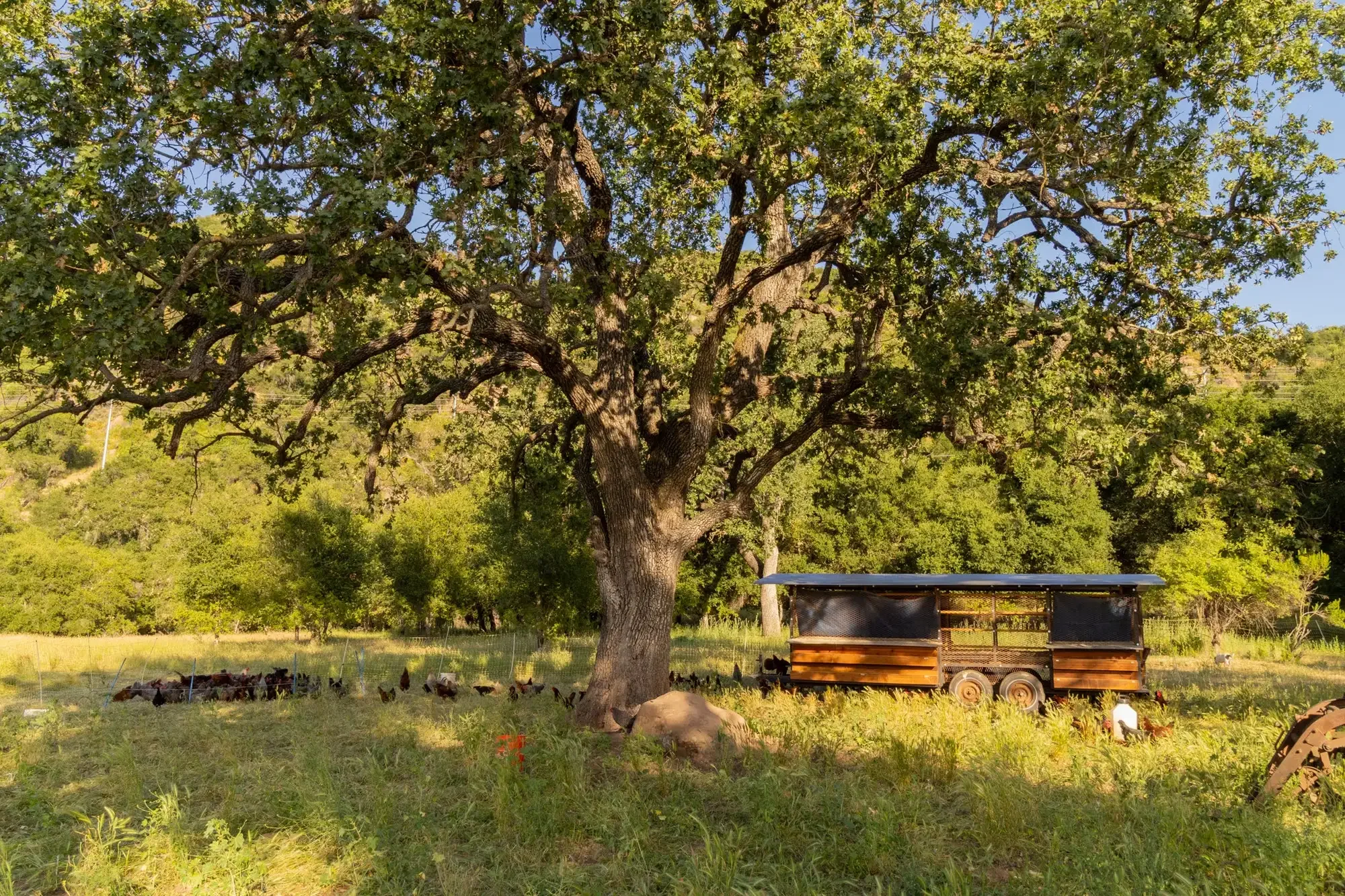
mobile chicken coop
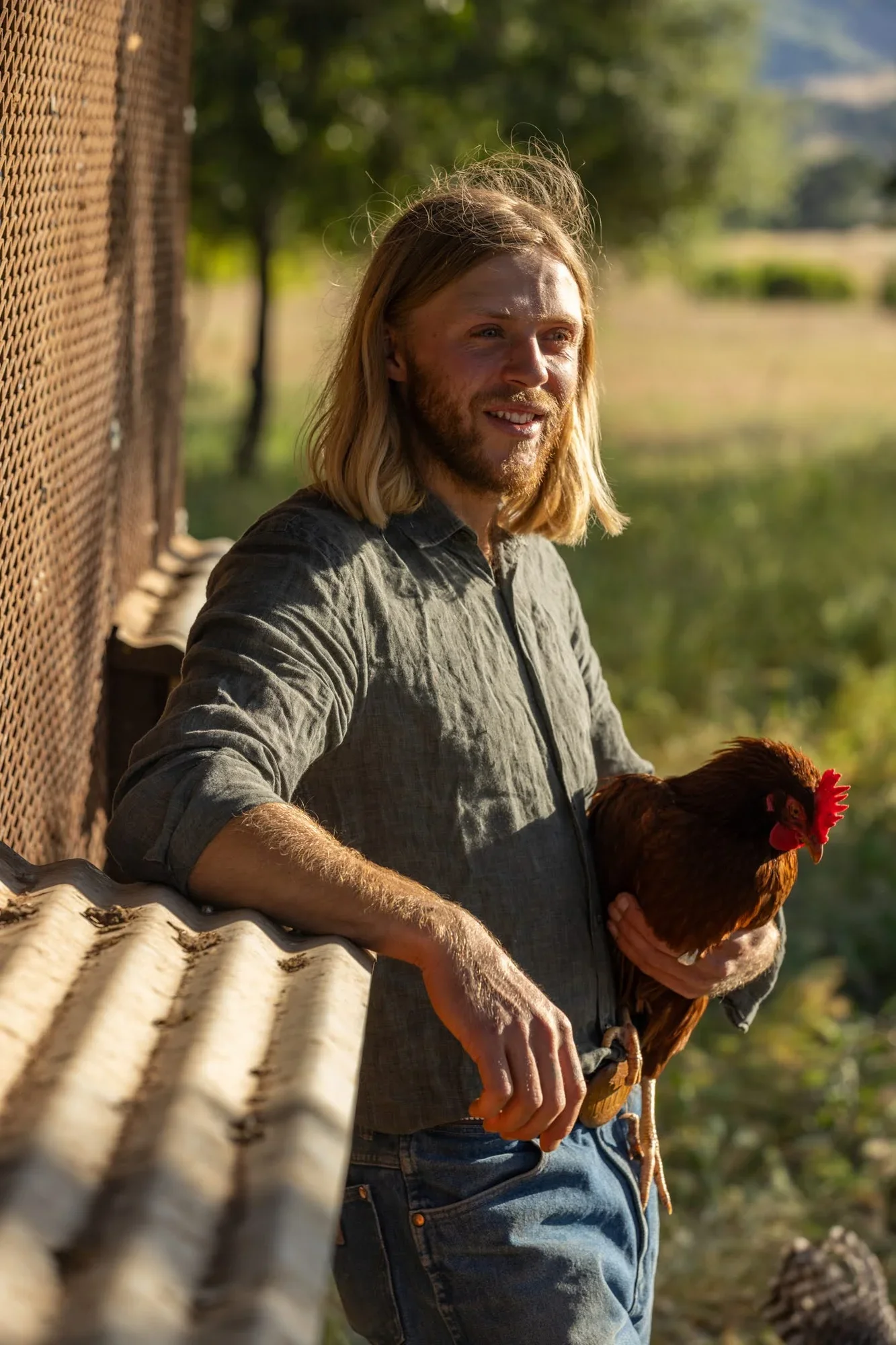
Catching up with Corban Fairbanks requires a bit of hustle. Between delivering his pastured Corb’s Orbs eggs to several popular vendors throughout Ventura, LA, and Santa Barbara counties, tending to a 450-bird (and growing) flock of chickens on hundreds of acres of pasture, and shepherding sheep and goats, he’s on the move from first light to sundown, seven days a week. It’s the life that centers on regenerative agriculture and healthy, happy animals, and he wouldn’t have it any other way.
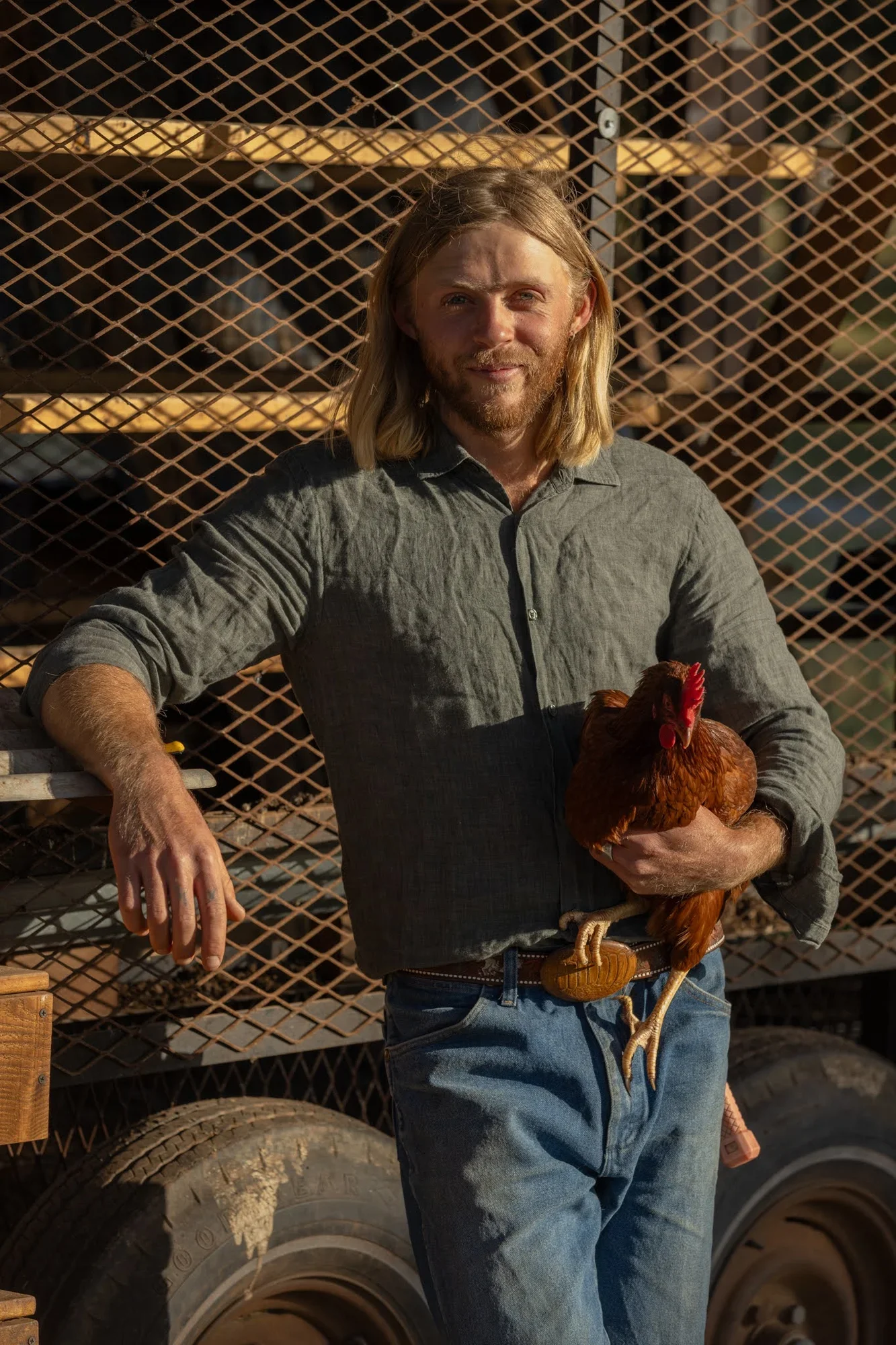
CORBAN FAIRBANKS
Corban always knew he wanted his job to include animals. He moved with his self-described “hippie” family to Ojai 14 years ago. He recalls a colorful, homeschooled, and free-roaming childhood and over 30 prior moves around the country — including stints in South Carolina, Florida, and Hawaii — before settling in Ojai. The second-oldest of seven siblings, he was the kid who brought lizards and snakes into the family home and held a dream of living in a treehouse with “12 to 18 dogs.” He’s manifested a version of that now, living off-grid with his girlfriend and eight guardian dogs on RMR Ranch, a 1,000-acre regenerative farm in Ojai where he raises flocks of chickens grazed rotationally with the farm’s resident sheep and goats.
Rotational, or prescribed grazing, means Corban’s chickens follow RMR’s sheep and goats around the ranch. The chickens help to improve the soil and pasture health by reducing pest insects, eating weed seeds, and spreading their manure around the land. Each animal has a role in enriching the pasture.
A typical day finds him up with his coffee at about 5:45 AM, followed by breakfast (toast and, obviously, eggs). He makes use of any cracked eggs he’s collected that week by throwing them into a pan to create a giant frittata for himself and his girlfriend. He checks on the electric fence line and the sheep and the goats, moving them and the chickens to different pastures as needed. He typically gathers 30 dozen eggs over the course of each day from his two home-built mobile coops. He washes any eggs that have dirt or debris. Vendors require the eggs to be cleaned and refrigerated. Unwashed eggs contain a natural coating called a bloom that seals the egg’s pores and prevents bacteria from growing; stored at room temperature, they will keep fresh for months.
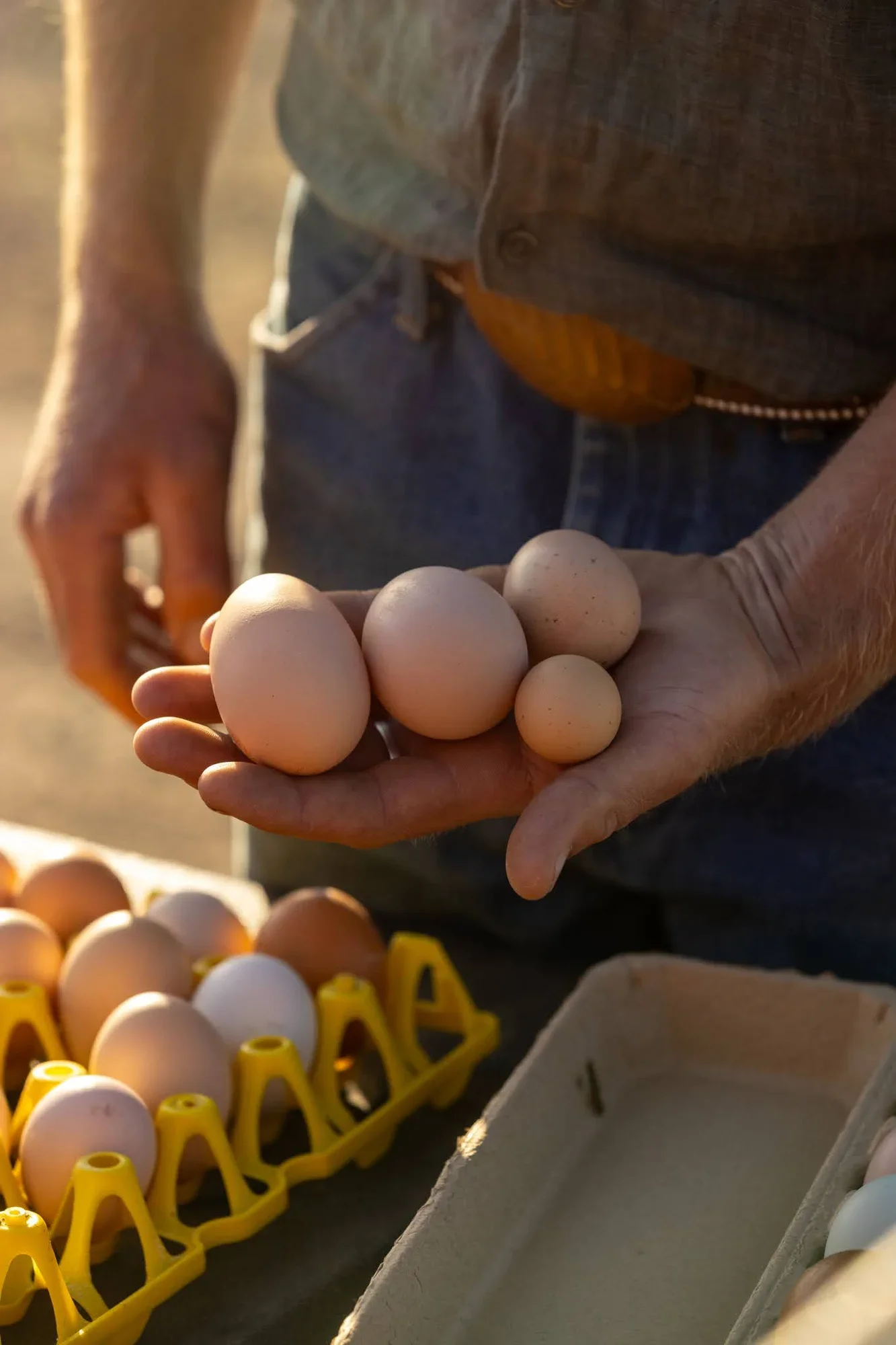
VARIETY OF EGGS
Next come the deliveries using his 4x4 Nissan Hardbody and a bunch of coolers and ice. He provides his eggs to local restaurants such as Rory’s Place and Rory’s Other Place. Rainbow Bridge recently began carrying Corb’s Orbs and sold out on the first day. They’ve since gone through 75 dozen in four days. His eggs can also be found in Santa Monica’s Farmshop. He delivers to Coyote Market in Carpinteria, Model Citizen restaurant in Ventura, Little Mountain restaurant in Montecito, and Manifattura — which uses his eggs in its fresh pasta — in Santa Barbara. Currently, the demand for his eggs is outstripping supply, and he estimates he can scale up to a 1,000-bird flock in 2027.
His chickens, he says proudly, never receive vaccines or antibiotics. Their food is organic, certified non-GMO and non-soy; they forage on grass, insects, and grubs; they get daily supplements; and they’re in an open-air coop with abundant access to verdant pastures. They move to fresh pasture every few days with the use of mobile chicken coops and electric fencing to keep predators away. Livestock guardian dogs are always nearby to protect the flock. The chickens go into their mobile coops when they wish, to lay eggs or roost for the evening.
RMR Ranch is a working 1,000-acre regenerative farm less than a mile from downtown Ojai. RMR recently became certified by California Certified Organic Farmers (CCOF). For the past five years, its owners have worked tirelessly to restore the overgrazed and depleted land, renewing soil health through rotational grazing with goats and sheep (in partnership with Dylan Boekan of Boekhouse Hearth & Husbandry), and now with Corban’s chickens. It’s paying off. The land is now home to 30 acres of heritage wheat and up to 100 species of native grasses “that haven’t otherwise been seen for like 50 years,” Corban says. The wheat provides five times the density of feed for the animals. Once the wheat is harvested, they will feast on the remains. Then, a cover crop such as clover or turnips is planted, allowing the soil to reset. The cover crop is later terminated, the animals rotate through the pasture and enjoy the leftovers, and the soil is ready once again for planting.
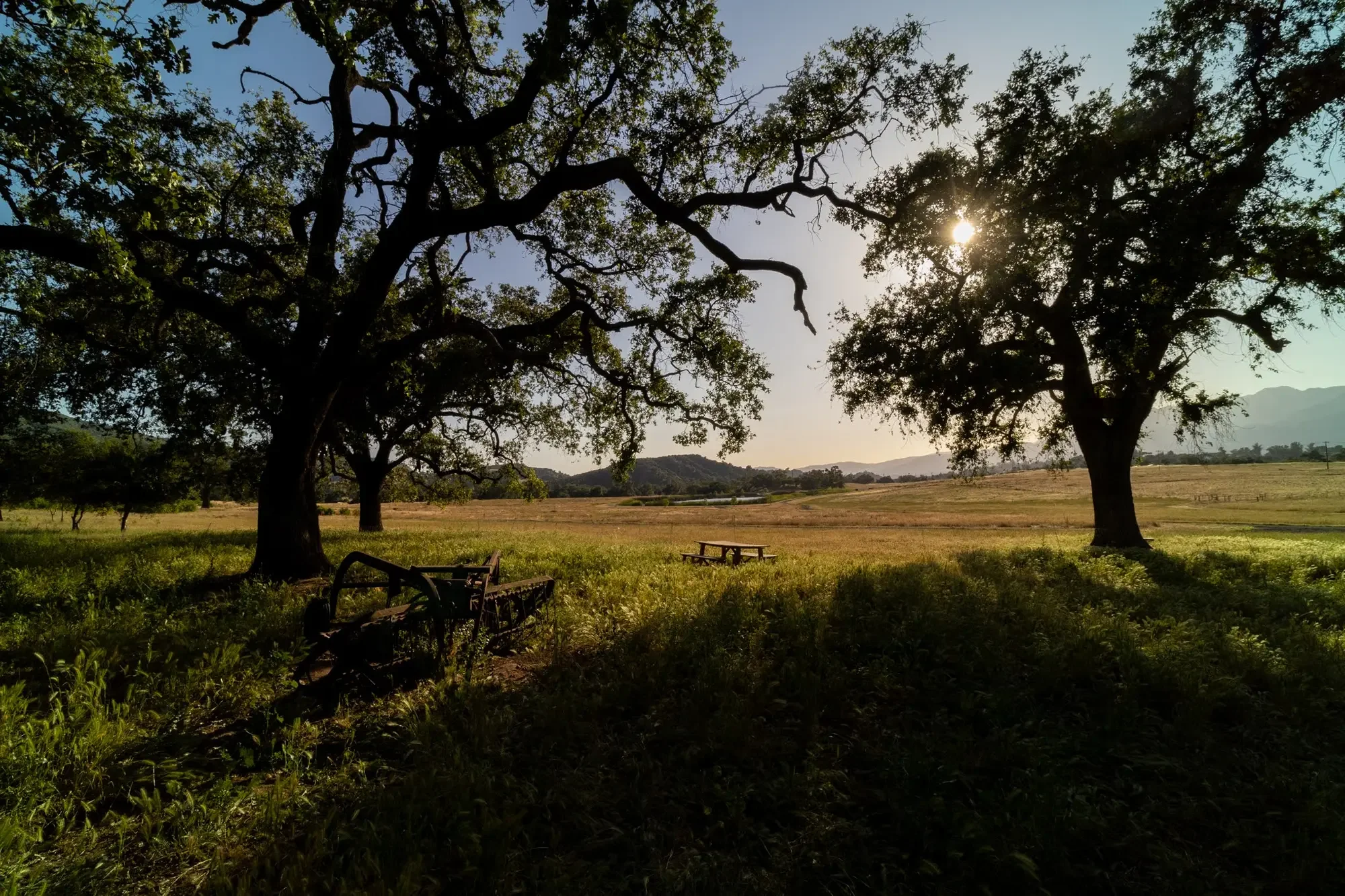
RMR RANCH
Walking RMR’s land with Corban, you can feel the vitality of the pastures, the native grasses and chaparral abundant and hearty, the earth rich and fragrant. His work, he acknowledges, is a tough — albeit rewarding — solo act, and he’s looking forward to hiring his first employee, likely toward the end of 2026.
“When I have more birds, I’ll be ready for someone to help out. I’m stamping egg cartons in the back of my truck right now, but pretty soon, there will be a whole facility for prepping eggs. I’ll have an employee doing the stamping, egg washing, helping with deliveries, feeding the animals, and moving the chickens. I’m looking forward to that!”
Corban’s keen interest in regenerative agriculture was seeded in his years working in restaurants and farm-to-table businesses from the time he was a teenager. He counts the popular Ojai private chef Chase Elder as an early mentor.
“She saw that I was passionate about cooking. She really took me under her wing. She showed me this other side of cooking, visiting local farms, getting inspired by the local produce, getting our hands in the dirt.”
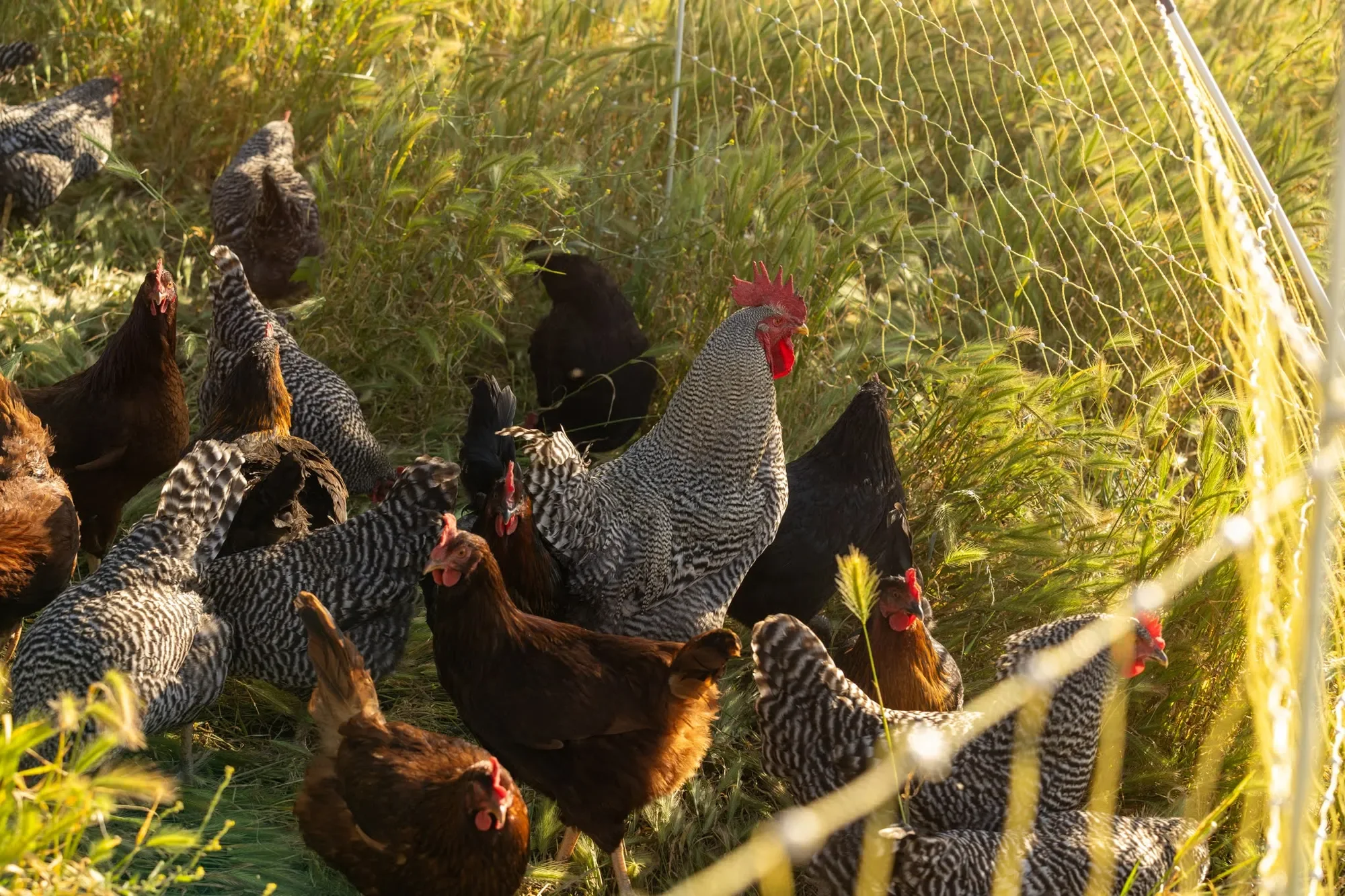
HAPPY CHICKENS
He developed a fascination with sourdough bread in 2020 during COVID and became obsessed with YouTube videos of 150-year-old traditional French breadmaking practices (all in French, with no subtitles). It was true old-world style baking, he says, mixing bread in massive wooden troughs with nutrient-dense heirloom grains and a multitude of beneficial bacteria from the starter.
“I’m a nerd! When I get into something, I try to learn everything I possibly can,” he laughs. His bread became popular with local businesses, and he worked as a bread baker for Rory’s. In 2023, he was inspired to use his culinary wares to coax his way into a volunteer — and later paid — position helping with the goats, sheep, and guardian animals owned by The Shepherdess Land & Livestock Co., a woman-owned prescribed grazing business based in Upper Ojai. Her business provides vegetation management services, land stewardship consultation, education, and shepherd training. “I met these shepherds downtown, and I knew instantly that they were my people,” he recalls.
He brought the owner, Brittany “Cole” Bush, and her crew fresh homemade bread, kombucha, and cheese. His gifts worked, and he was invited to join her team to help with the animals and provide chef services for the crew. “I essentially became what they called the ranch mama, which is like the caretaker,” he says. His charges included donkeys, horses, and a combined group of goats and sheep affectionately called a “flerd.” He also shadowed the shepherds, learning about rotating livestock through pastures.
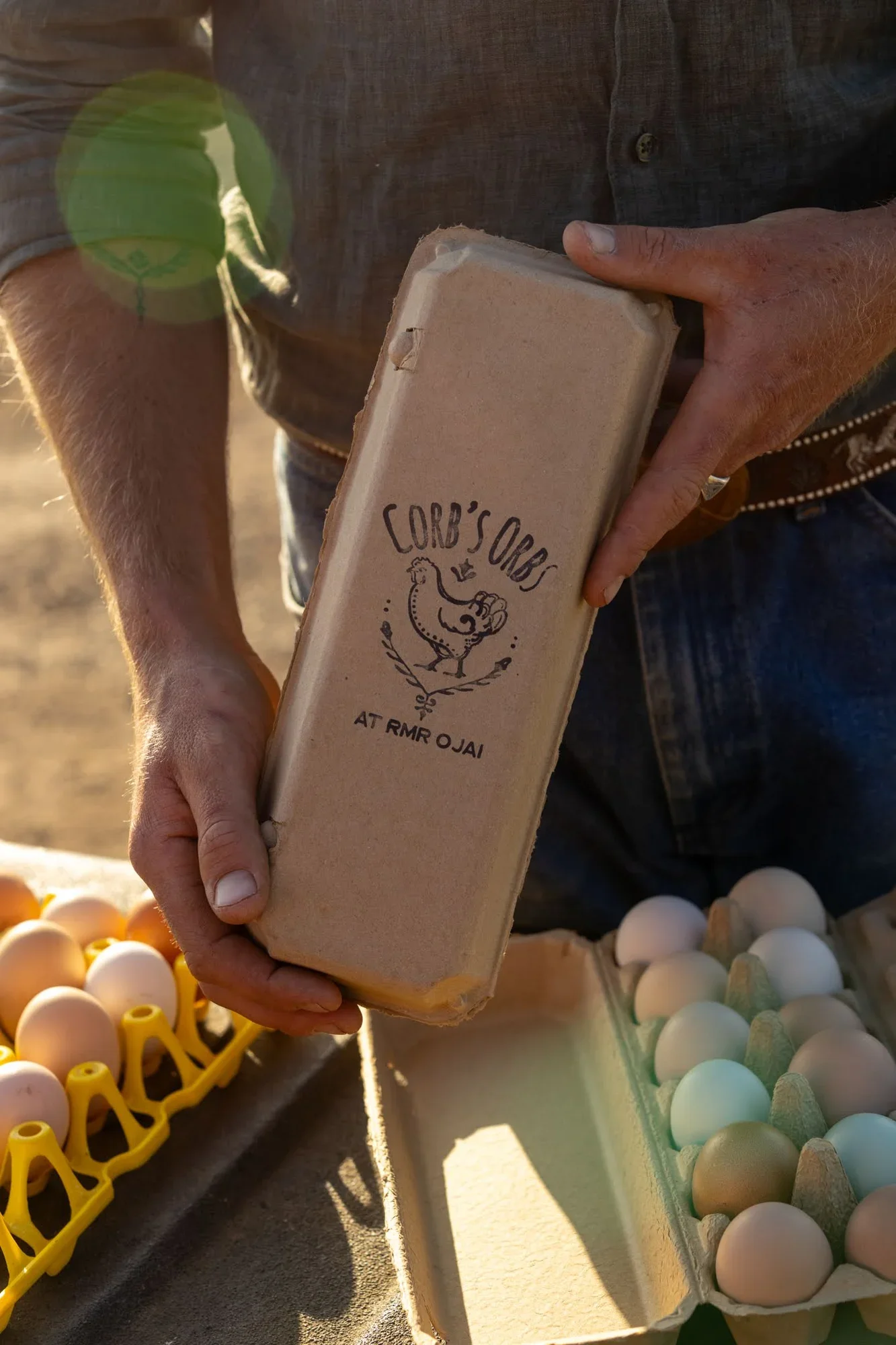
CORB’S ORBS LOGO DESIGN BY andromeda FAIRBANKS
Almost immediately, he asked if he could introduce chickens to Cole’s land. She agreed to 30 chickens; Corban showed up with 65. “That’s basic chicken math. If one doesn’t make it, you have several more.”
He credits Cole with providing an invaluable training ground for many young farmers like himself and Dylan to grow and thrive. “Some of us had very little experience getting started, and her business has been a major stepping stone. I’m so grateful to her.”
Corban had almost no previous experience with chickens, pastured or otherwise. As he had done with his sourdough bread, he launched into action and taught himself. He fashioned temporary coops for the month-old chicks out of existing aviaries on the property. From there, he set to work building a mobile coop out of repurposed materials.
“It was a Facebook Marketplace kind of venture,” he says.
He purchased a boat trailer to provide the frame, fashioning an open floor coop with an expanded sheet-metal bottom, built with a wide gap to allow waste to fall through. The coop also contained “roll-away” nest boxes with a comfortable, breathable, easy-to-clean rubber lining. The nest boxes were constructed to funnel freshly laid eggs away from the hen, keeping them clean and easy to retrieve.
Mobile coops allow for chickens to be rotated throughout multiple pastures; while in the coop, their manure drops through the bottom to fertilize the soil below. They are allowed to roam free as well, thanks to mobile electric fencing that Corban constantly moves and reinstalls. Moving the chickens through different pastures also provides shade and forage variety for the birds at different times during the week. Only one portion of pasture is grazed at a time, while the remainder of the pasture “rests” and regenerates.
“I learned so much about the environmental impact of rotational grazing. Chickens are an amazing tool. First, you bring the cows through the pasture, then the sheep and goats, then the chickens. Each animal helps the soil in a different way.”
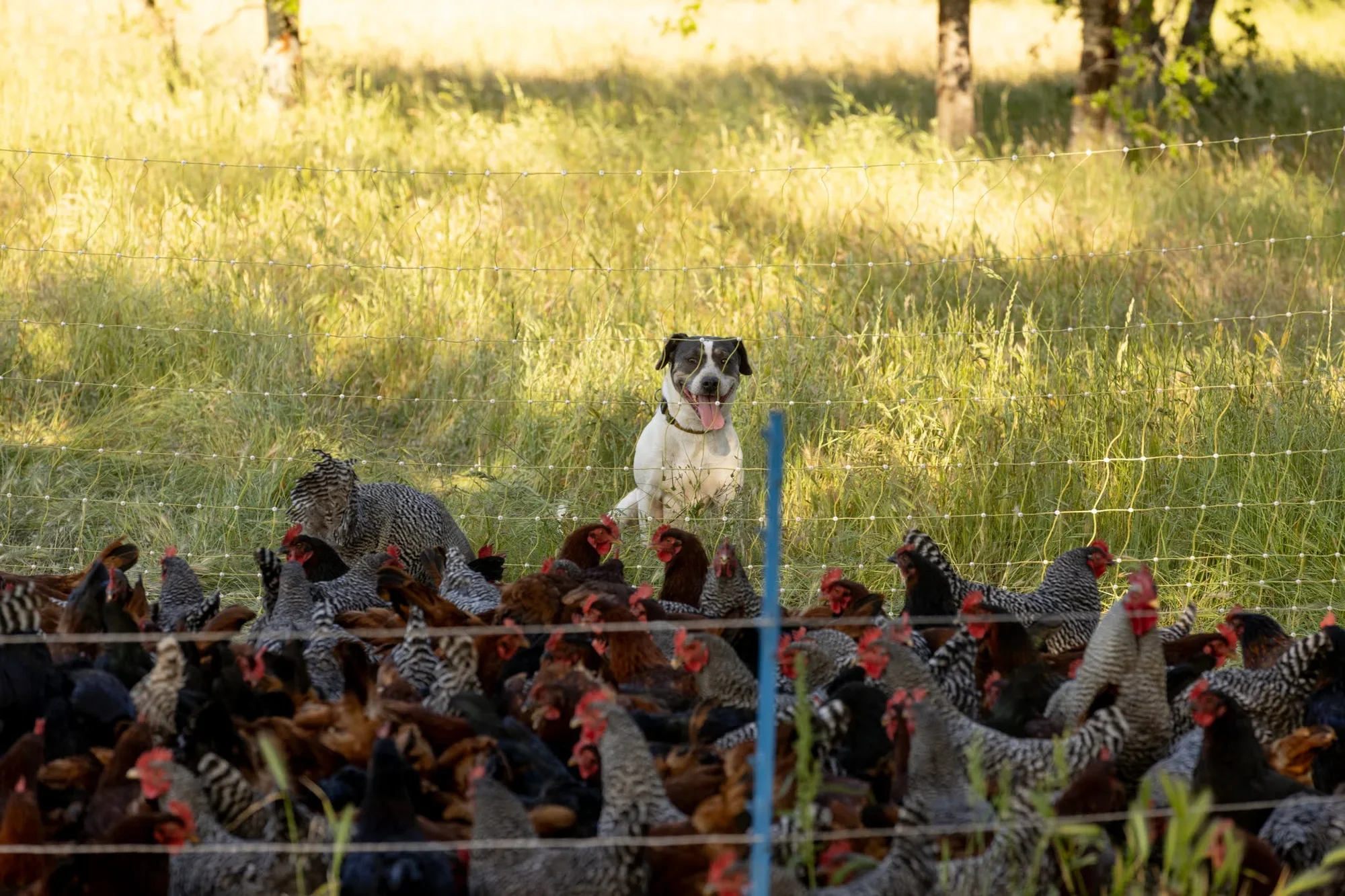
CORBAN’S DOG, YURI
In this type of grazing, cows eat tall grasses and leave manure that is so beneficial to the soil that it’s often referred to as “liquid gold.” Sheep graze closer to the ground, compacting the soil and creating a sort of mulch which keeps the soil cooler in the summer and also makes it more spongelike, retaining moisture more efficiently. This helps grasslands to germinate. Goats, as browsers, prefer woody shrubs, brush, and weeds, making them adept eliminators of invasive species and overgrowth. Chickens forage, pecking and scratching up the existing manure and spreading it, eating insects, fly larvae, and other parasite eggs — natural pest control — and add their own nutrient-rich manure, completing the cycle.
The list of benefits is significant. Resting grazed paddocks (a divided portion of pasture) allows forage plants to recover and deepen their root systems. Other advantages include decreased soil erosion, more carbon capture, lower greenhouse gases with healthier soil, less reliance on chemical fertilizers, and increased biodiversity of plant life — a win-win for native flora and fauna and happier, more robust livestock.
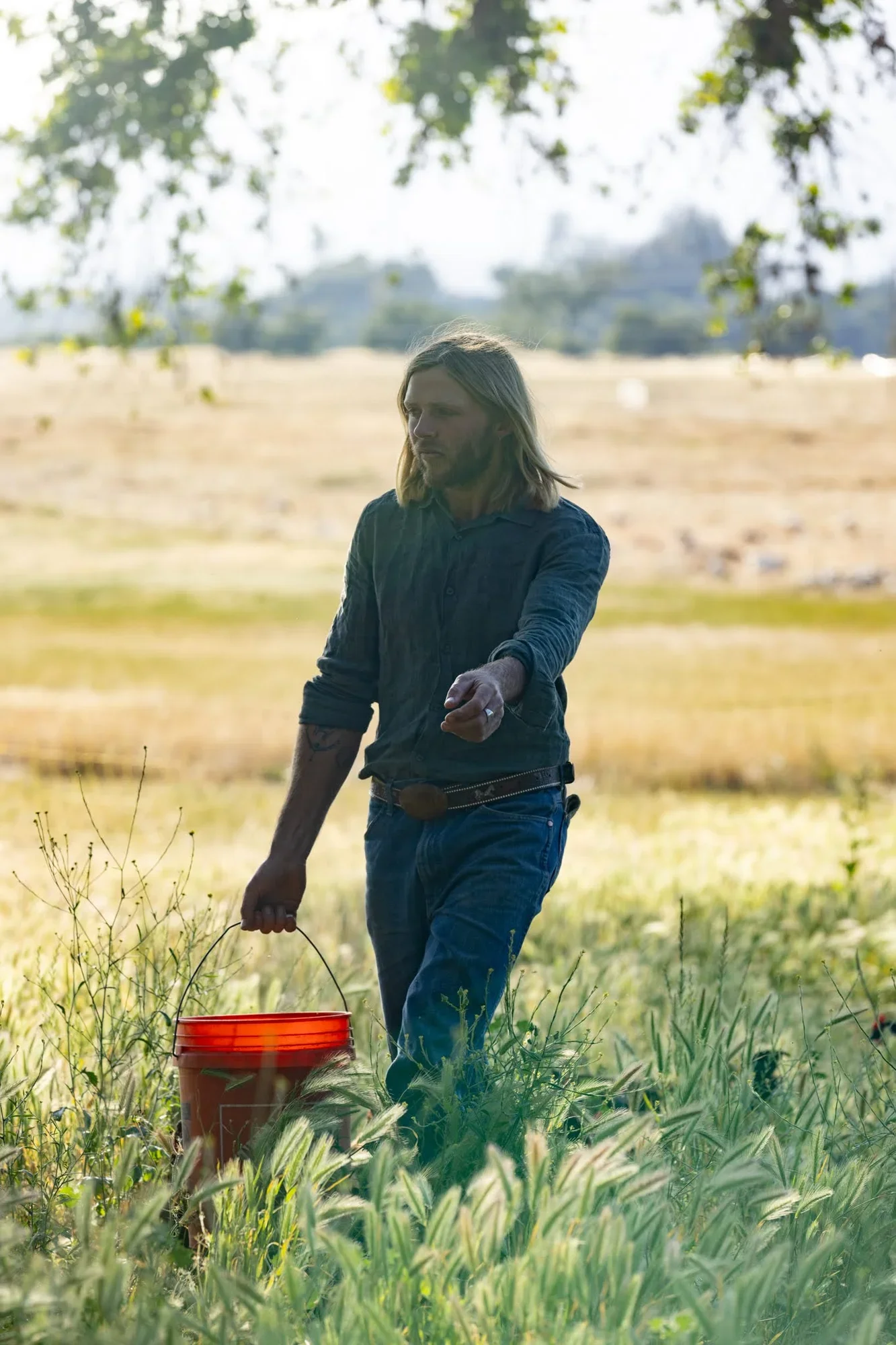
FEEDING CHICKENS
Pastured eggs offer a superior nutritional profile as well. In addition to providing a healthier, more humane existence for chickens, raising them on pasture results in eggs that contain higher levels of heart-healthy omega-3 fatty acids, fat-soluble vitamins (like A, D, and E), and vital antioxidants.
By 2025, Corban’s flock and his business had grown significantly. He’d been helping RMR partner Dylan with his sheep, and piqued the interest of the RMR owners when he mentioned that his chickens could help enhance both their soil health and pest management. Corban’s methods aligned with RMR’s philosophy, and his business was steadily growing in value. A new partnership was born. He arrived with his flock and 300 new chicks. The new flock took residence in a second, larger mobile coop that started as a rendering he created with his close friend Abigail Zuckerman, an Ojai-based architectural designer. Another friend, Cameron Kunde, helped with the building fabrication. They are planning a new coop that will fit 400 birds.
“Who wouldn’t want to raise chickens at RMR?” he adds. “It’s one of the best stretches of pasture in Ojai!” He’s now looking forward to gaining his own CCOF certification in the near future.
His goal is one egg a day per chicken in the spring. He chooses breeds that are resilient in hotter climates. His current flocks include brown egg producers Rhode Island Reds, Barred Rocks, and Black Sex-Link (when they hatch, you can tell female from male by their feather color). His Ameraucana eggs are blue, green, and pink; Cream Legbar eggs are blue, and Black Copper Marans are dark brown and speckled. All of his chicks are sourced from hatcheries that do not administer antibiotics or vaccines. Unlike many hatcheries, the ones he uses do not terminate roosters (they are often, unfortunately, viewed as disposable) but rather sell them for meat.
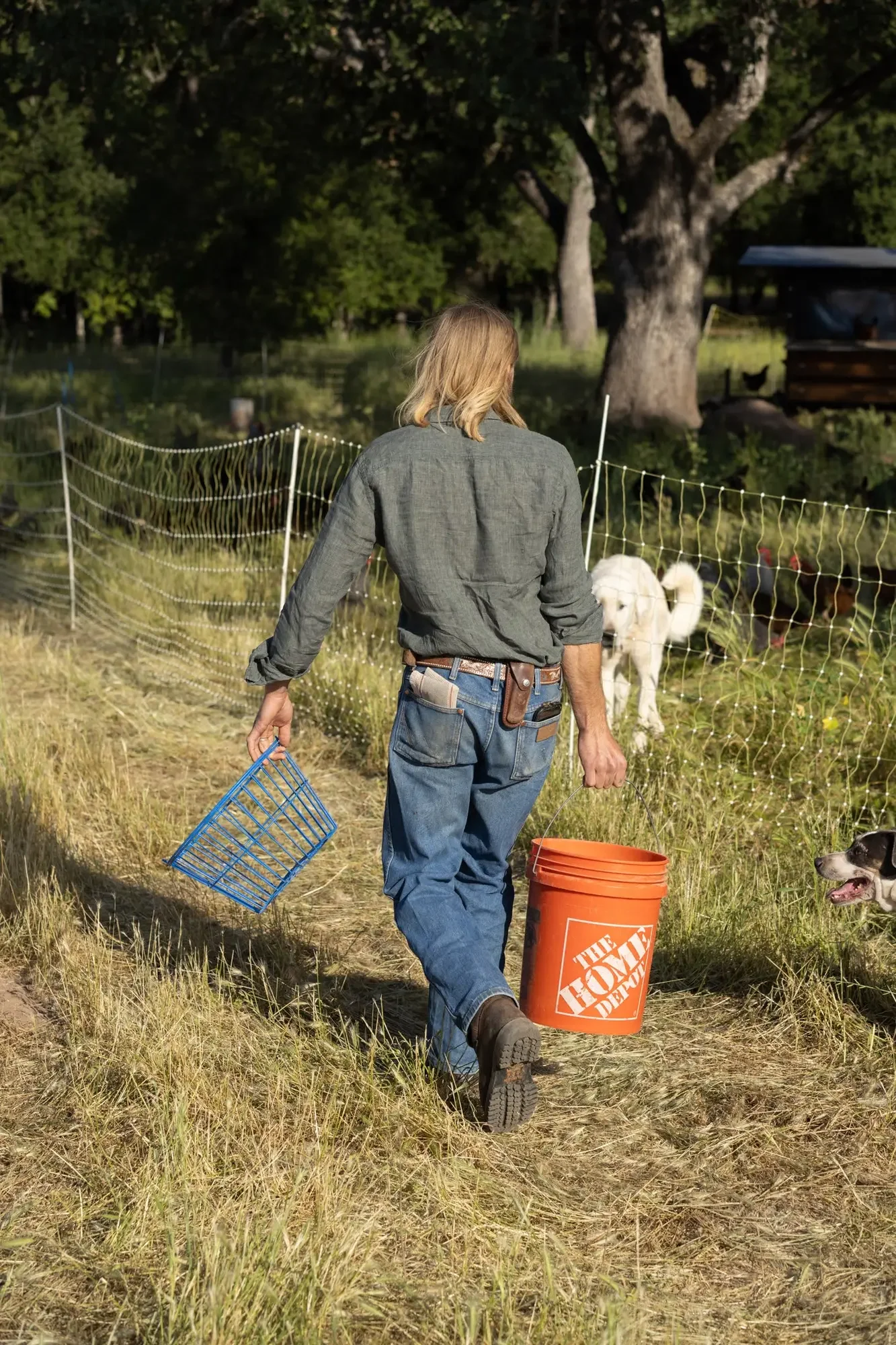
GUARD DOG HUGHIE AND YURI WITH CORBAN IN THE PASTURE